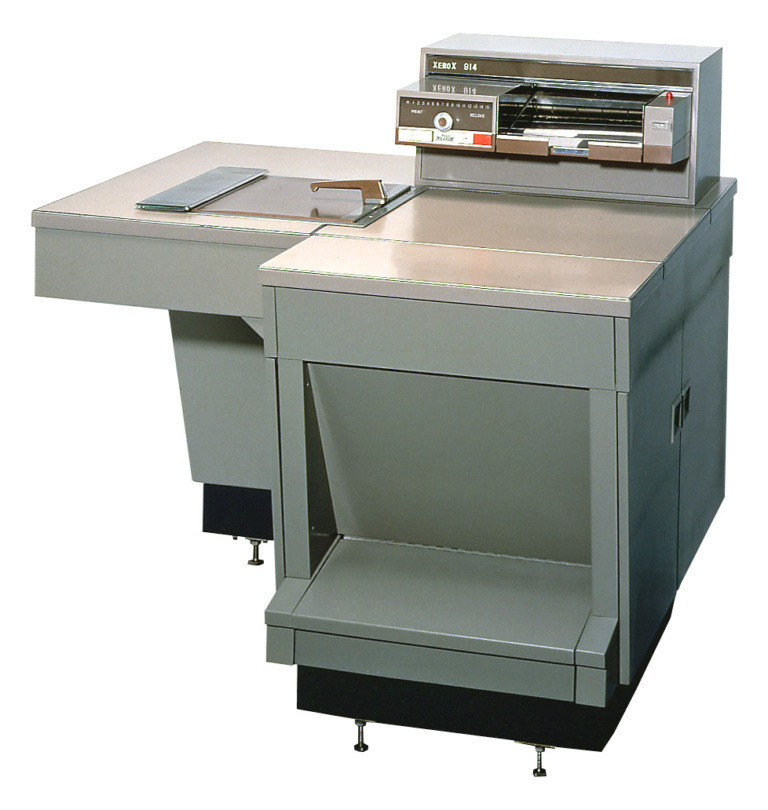
The Xerox 914 automatic photocopying machine was first produced in 1959 by Haloid Xerox. It reproduced documents with a process called xerography, wherein an electric charge would first be uniformly distributed along the surface of a rotating selenium-coated drum. The original document would then be sent over the drum roller, at which point light would pass through the blank portions of the paper and be reflected onto the drum. The electrostatic charge would form a “latent image” where light did not reach, due to being blocked by any image or text on the original. Negatively-charged toner granules would attach to the electrostatic image formed on the drum. The toner would then be applied to the positively-charged blank paper. After applying heat to fuse the paper and toner, an identical image would be finally formed on the new sheet of paper.
Xerography may seem complex, and it was—until the Xerox 914 was developed. After the original document was inserted, all that was needed was the push of a button. It was simple enough to operate that it was the first copying machine to become mainstream in offices. It even went beyond the workplace, entering the public sphere and changing the world forever. One of the ways it directly affected American public opinion was in 1971, when a Xerox photocopier—most likely a 914 or a similar model—was used to compile a shocking dossier regarding secret American involvement in Vietnam.
The classified documents detailing American intervention in Indochina were first commissioned in the late 1960s by Secretary of Defense Robert McNamara. In 1969, disillusioned MIT researcher and former Department of Defense employee Daniel Ellsberg took it upon himself to reveal to the public what was really happening in the region. With the help of his children, the 47 volumes of top-secret documents were replicated using a Xerox copier, before being forwarded to the New York Times and The Washington Post. On June 13th of 1971, the New York Times began publishing the information that would become known as the Pentagon Papers—and so the floodgates were opened.
It was revealed that the Truman administration provided military backing to France against the communist Viet Minh during the First Indochina War, which commenced in the wake of World War II when French Indochina attempted to gain independence. When the war between North and South erupted in 1954, the United States began supporting the South and even bombing the North. Kennedy's administration expanded the scope of the war and was involved in the assassination of disfavored South Vietnamese President Ngo Dinh Diem. Johnson further expanded offensives against North Vietnam well before the level of American involvement was publicly known. His administration also intensified bombing campaigns against North Vietnam—despite official statements to the contrary, the Pentagon Papers revealed that the government knew full well that the bombing did not affect North Vietnamese morale. All the while, Congress was found to have systematically lied to the public as well.
The embarrassing leak was initially blocked by the Department of Justice, but the Supreme Court lifted this injunction on June 30th due to insufficient justification to suspend publication. The Pentagon Papers enraged the public, who became aware of not only the level of direct involvement but government misinformation spoon-fed to the people for years. Growing dissatisfaction towards the Vietnam War reached a tipping point not only in the US, but across the world. It was a major embarrassment to President Nixon, who took illegal action in an attempt to disgrace Daniel Ellsberg. Like many other unlawful endeavors undertaken by Nixon, these measures were also publicly revealed by the Watergate investigation.
Without the Xerox photocopier there would never have been any Pentagon Papers. The copying machine directly enabled the reproduction and release of thousands of pages of incriminating documents. These shocking revelations outraged the American public, who began to further question the credibility of the government. The Pentagon Papers were hence an example of the effect photocopiers had on American culture, making the Xerox 914 an appropriate selection for this museum. No secret could be kept secret for too long; all that was needed to leak top-secret information was a photocopier and a disenchanted insider.