Napalm, also called firebomb fuel gel mixture, is a jelly-like substance that comes from a powder mixed with gasoline. It is highly flammable, causing it to ignite on impact with a target, burning at over 2,760°C. Compared to previous technologies, napalm burns longer, is harder to extinguish, and can stick to the target due to its consistency, causing fatal injuries.
Although napalm was created in 1942 during the Second World War (WWII) and was used to bomb Japanese cities, the technology's arguably most notable impact came later on, during the Vietnam War, when a new easy-to-make variant was created. It consisted of a mix of gasoline, benzene, and polystyrene, and it was pushed into the public eye.
In 1965, the Pentagon requested bids from 17 US companies making polystyrene, with one winning bid being from the Dow Chemical company in Michigan. Around the time, the Dow company ranked 75th on a list of military contractors, and it was largely known for making Saran Wrap. However, soon, it became the military's only supplier of napalm, and knowledge of the company soared, with 88% of individuals polled in one survey saying that they knew of Dow. This was a major rise, and the new number of those who knew of the company was comparable to some of America's largest corporations. This meant Dow's actions could now have a big impact on US citizens and their opinions.
In Vietnam, napalm had horrifying, cruel consequences. It caused severe burns all over the body (worse than those caused by regular fire) and melted the flesh off. Wounds caused by it were also too deep to heal, and there was no real way to put the fire out except by smothering it. Thus, when people would try to wipe it off, this only caused the fire to spread, resulting in immense pain. Soldiers seeing these impacts first hand described burnt eyelids that couldn't be shut and flesh that looked like “swollen, raw meat.” Furthermore, in an enclosed environment, napalm caused the carbon monoxide poisoning of those not directly hit, which was incredibly dangerous and painful.
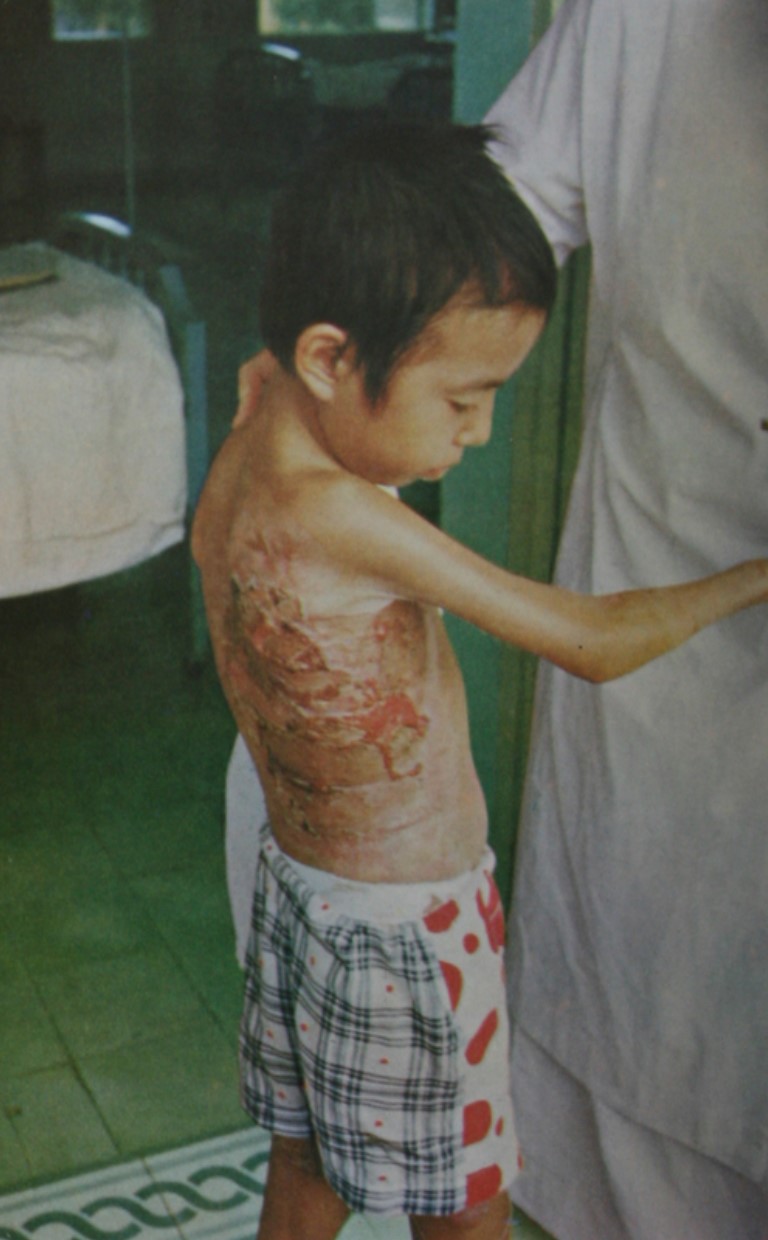
As Vietnam was the first televised war, people from the US began seeing images of civilian casualties caused by napalm bombs. Newspapers and magazines showcased them, as well, including a January 1967 article in Ramparts magazine, which contained color photographs of mutilated Vietnamese children (such as the artifact above). This specific image shows a young boy with scars caused by napalm burns; these injuries and even worse were the norm when the substance was used against the Vietnamese.
These images and the use of napalm fueled the anti-war sentiment and movement in the US public, and they helped encourage Martin Luther King Jr. go public with his opposition to the war. Seeing the substance's horrific consequences and knowing of Dow as its manufacturer, many students also began to protest recruiters from Dow coming onto college campuses. In October 1966, the first demonstrations occurred at the University of California Berkeley in California and the Wayne State University in Michigan. Over the next year, over a hundred more protests would take place. In this way, Dow became even more publicized. For some students, it became a “badge of honor” to be interviewed by Dow recruiters, causing the number of interviews to increase. In interview rooms, recruiters were often trapped, spat on, forced to leave through back exits, and called “baby killers” for the company's actions.
In an attempt to improve the company's image, Dow distributed “Napalm News” to employees and held an aggressive public relations campaign. It claimed that, according to military officials, napalm was only being used on military targets and that the company wasn't responsible for the military's actions. Despite this, the images and news coverage coming from Vietnam drastically impacted people's opinions of the Dow company, making it the target of anti-war activism. Due to the extreme backlash and losing the contract for producing napalm, the Dow company stopped making the substance in 1969.
Anger about the war also drove annoyance at and distrust in the government, with many believing that the war was being gravely mishandled and that the US was being unnecessarily cruel. This created a divide between officials and the people. Citizens now regarded government actions with heavier skepticism and suspicion than before, something that can still be seen today. Although napalm wasn't the original reason why citizens got angry, it did add to their anger. In fact, the substance was even used as a symbol for the war by activists in order to bring into question the morality of the military tactics being used.
Thus, this artifact was selected as it was one of the major things driving public opinion against the Vietnam War. It helped to fuel many protests and thus had a huge impact on how the people viewed the US's military tactic of using napalm, along with harming public sentiment about the Dow company.