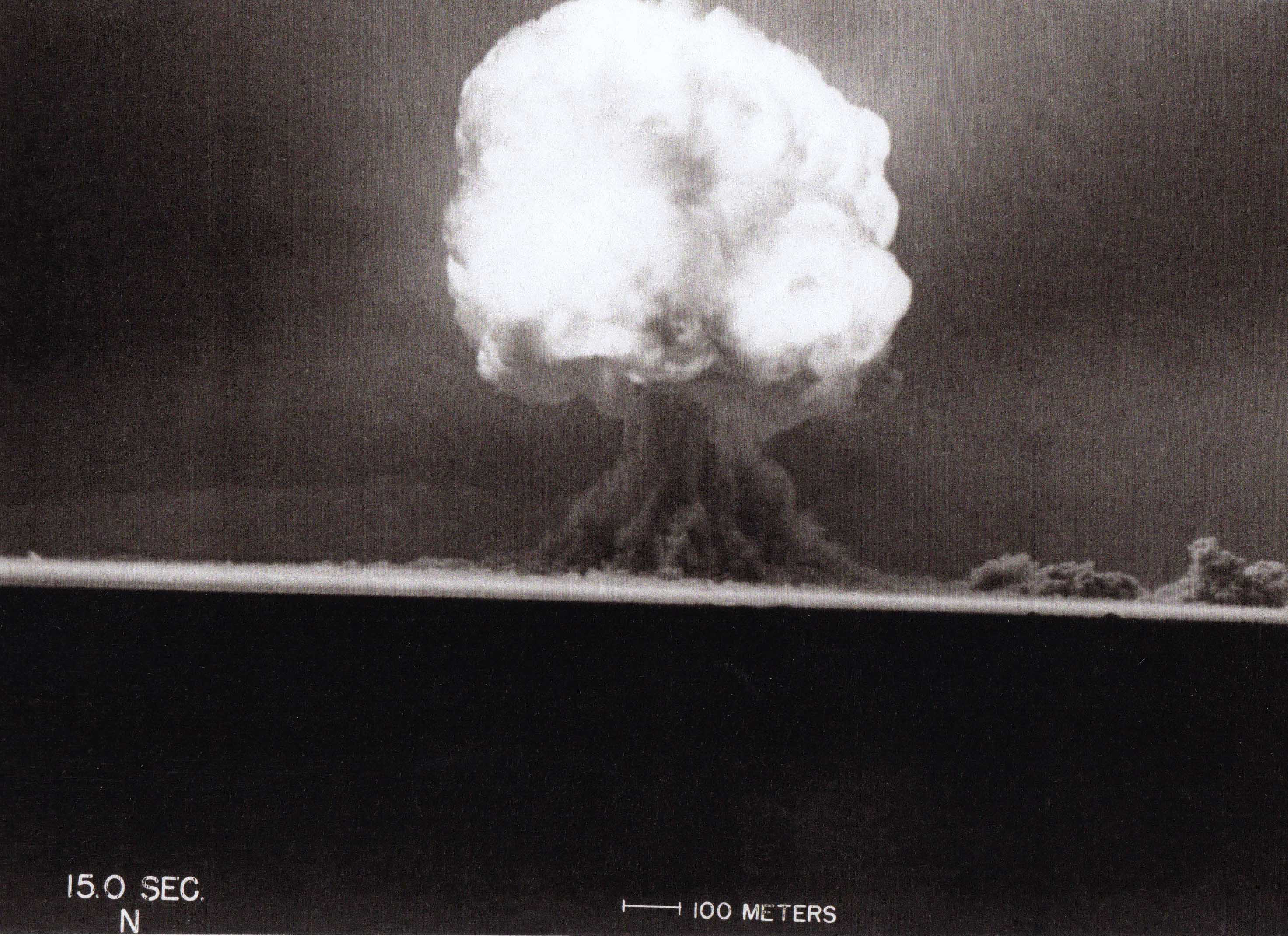
The Manhattan Project was created in 1941 after US intelligence found that Nazi scientists had been working on a nuclear weapon. The goal was for the US to create such a weapon before other countries had the chance. These efforts culminated in the Trinity Test on July 16, 1945, when the "Gadget," the world's first nuclear device, detonated in the Jornada Del Muerto Desert in New Mexico.
The Gadget, which caused the explosion photographed by David Wargowski in the artifact to the left, was a plutonium implosion device shaped like a large steel globe. It had plutonium in the middle with regular explosives around it, and, when the explosives detonated, the plutonium was squeezed, resulting in the fission chain reaction needed to explode the plutonium. The explosion generated an amount of force equivalent to about 15,000 to 20,000 tons of TNT. Thus, the first successful atomic bomb had been created, ushering in the Atomic Age.
In early August 1945, using the nuclear technology developed by the Manhattan Project, the US bombed the cities of Hiroshima and Nagasaki in Japan with the "Little Boy" and "Fat Man" bombs, respectively. (The Little Boy was a gun-type uranium bomb, while the Fat Man was a plutonium bomb similar to the Gadget.) The goal was to demonstrate the bombs' power and make the Japanese surrender in the Pacific Theatre of World War II (WWII).
After this point, the atomic testing at Trinity was publicized. The Manhattan Project was thrust into the public eye, and most people believed that the use of the bombs had ended the war and saved American lives; after being at war for almost four years, most lacked sympathy for Japan. A Gallup poll was also held, showing that 85% of Americans approved of the use of atomic weapons on Japanese cities.
However, over time, varying opinions began to emerge, newly dividing the country on the topic of nuclear bombs. Some people felt that war now had to be abolished as any future world war would involve nuclear weapons and would thus end civilization. This caused campaigns for peace and disarmament and bolstered support for the United Nations (UN) that would help to unite the world. Conversely, others believed that nuclear weapons were necessary to keep the country safe and prevent other countries from attacking (i.e., as deterrence). Never before had atomic weapons been so public, and they would alter the world forever, with Secretary of State Stimson even noting that the bombs should be considered "a revolutionary change in the relations of man to the universe."
Furthermore, after the end of WWII, by 1947, the Cold War had begun taking shape as a political and economic rivalry between the US and the Soviet Union. Due to the US being the first country (before the Soviets) to develop a successful atomic bomb, many Americans and officials believed that it could be used to protect against and deter the threat of communism. After all, the US having a nuclear monopoly could limit Soviet options and be considered a danger to Soviet security, potentially making them less likely to act in a way that would harm the US. Although officials expected the Soviets to develop similar technology, American intelligence only believed this would happen in 1952 or later, and many felt that the US would be able to stay ahead, developing more weapons more quickly. However, the Soviets had sped up their atomic program in response to US developments, and, when, on August 29, 1949, they successfully tested their first nuclear device, RDS-1 or "First Lightning," America was shocked.
The Second Red Scare had already begun taking root, and this just added fuel to the fire. Many now feared that the Soviets had used espionage and had stolen American secrets in order to develop their atomic bomb due to its resemblance to the Fat Man. This played into the spread of McCarthyism and the support of various trials of suspected Soviets, with people seeking to find spies in both the government and the general public. The idea that spies could be anywhere spread like wildfire, creating an atmosphere of panic in the lives of average citizens. Additionally, the US no longer had a monopoly on functional nuclear weapons, making people fear that Soviets were becoming more powerful and thus causing a desire for the development of more weapons to once again be ahead.
Overall, there was a big shift in public opinion and US culture, with people fearing and wanting to be better than the USSR in levels never really seen before. As a result, the Cold War saw a drastic increase in nuclear arms production and the stockpiling of nukes, with both sides seeing them as a deterrent against war and trying to stay ahead in numbers. Although much of the nuclear arsenal buildup in the arms race would occur in the 1950s, the seed had been planted in the 1940s.
Thus, this artifact was selected as it played a major role in shaping the world for many years, and even decades, to come. Even today, we are seeing its impacts, with many debates about the necessity of nuclear weapons and related technology. In a way, the Trinity Test marked the beginning of the new age of nuclear weapons and their consequences. Further, although the bomb didn't create the Red Scare and the Cold War, it certainly fueled them, and, if not for the development of atomic weapons, conflicts with the USSR may not have escalated so drastically.