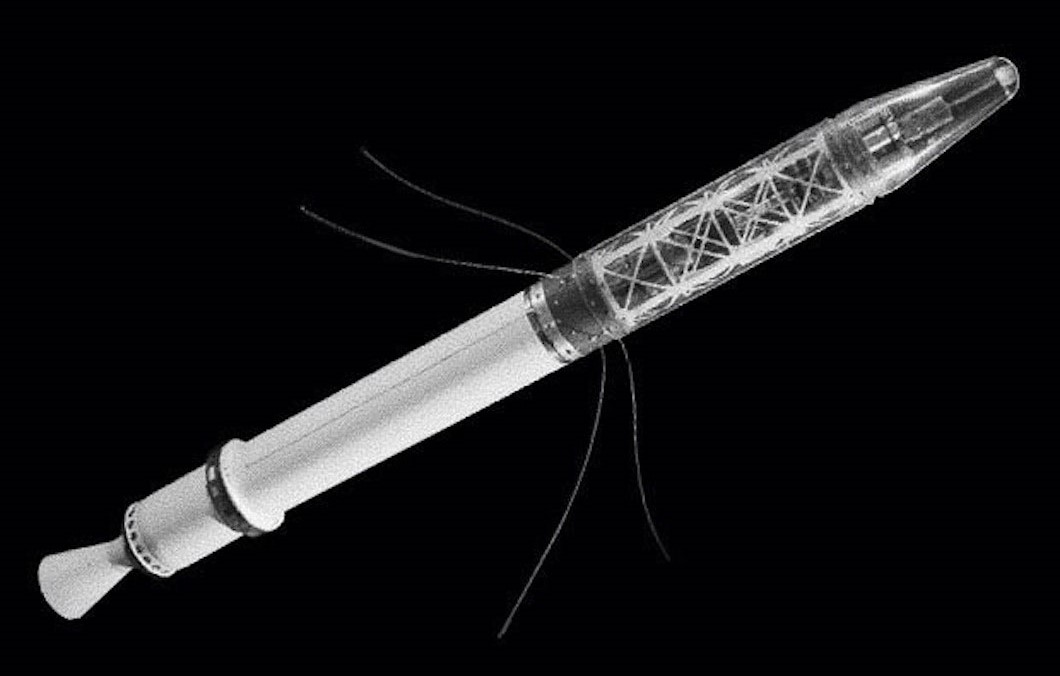
In 1958, the first U.S. satellite, the Explorer 1, was launched into space by the Jupiter-C rocket, a modified Redstone ballistic missile. The Explorer 1 was equipped with a cosmic ray detector to measure radiation while orbiting Earth. The measurements the Explorer 1 took helped Van Allen theorize the existence of radiation belts caused by Earth's magnetic field, which became the first scientific discovery from instruments in space.
In addition to its contributions to science, the Explorer 1 served as the United State's response to the success of the USSR's Sputnik 1 satellite and marked the beginning of the space race.
The launch of the Sputnik 1 on the R-7 intercontinental ballistic missile (ICBM) came as a huge shock to Americans. The Soviet Union had made the first victory in the space race, placing the artificial satellite in orbit. Despite Eisenhower and the US government's attempts to downplay the Soviet's feat, many Americans were still filled with anxiety and dread. They were worried that America was starting to fall behind the Soviets in technology, and during this time period, tensions between the United States and the Soviet Union were already extremely high due to the Cold War. The success of the Sputnik 1 launch was especially scary since nuclear warheads could potentially be launched on the same intercontinental ballistic missile that sent the Sputnik 1 to space. The fact that the Sputnik 1 passed over the United States 7 times a day and was visible to the naked eye did not help soothe any fears. So not only was the space race a competition of technology, but it was also an extension of the nuclear arms race. The Soviet's dominance in early space exploration also contributed to the idea of the missile gap: that the USSR had many more missiles than the United States. The period immediately following the launch of the Sputnik 1 became known as the Sputnik Crisis—a period where people began to believe that the Soviets were winning in terms of space exploration and technological development.
As the public's concerns continued to worsen, the United States began to pour massive amounts of money into the space program in an effort to catch up. In addition, the government began reviewing the defense systems and placed more importance on developing US intelligence. With the Soviet's early victories in the space race, America needed to show its technological and economic might. In 1958, the Explorer 1 was successfully launched, which gave a much-needed morale boost to Americans. Although it was not too particularly impressive compared to the Soviet's accomplishments (such as the Sputnik 2 which carried a dog into space), the Explorer 1 would be the first of many American forays into space. Later in the same year that the Explorer 1 was launched, Eisenhower signed a public order establishing the National Aeronautics and Space Administration (NASA). The accomplishments of the space race were heavily publicized, and some media could even be considered propaganda. This coverage intended to prove why the space race was so important and assure the public that the United States was winning. Nevertheless, tensions continued to grow throughout this time with the public believing that the United States should invest in space technology and missile stockpiling. This sentiment continued until towards the end of the space race and Cold War, when the Soviet Union started to collapse financially.
The Explorer 1 could be considered the start of American space exploration and led to massive improvements in technology and scientific research. Advancements in technology from the space race have greatly benefitted a variety of areas from computers to transportation to medicine. For example, the cell phone camera and the ear thermometer, things we commonly use today, were both developed during the age of space exploration. The launch was also the first step taken to compete against the Soviets in the space race and alleviate the public's worries about Soviet superiority. The Explorer 1 and other space missions have a lasting impact on culture and have been depicted in movies or other media. Even today, many people believe in the importance of continuing space exploration and research.