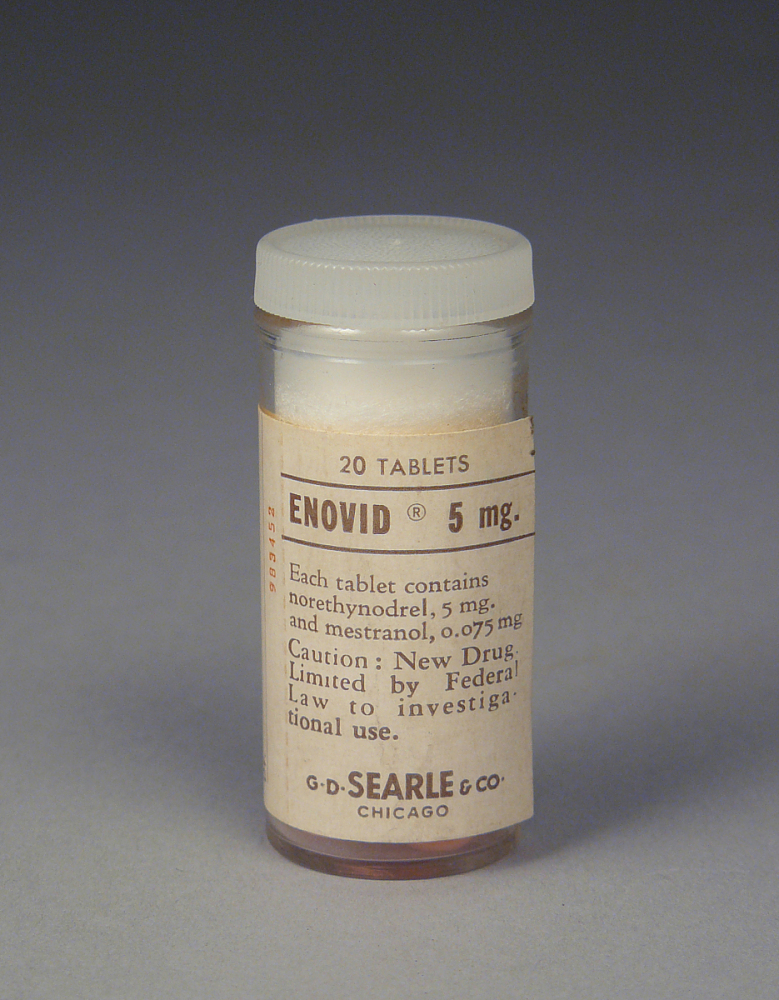
The first oral contraceptive, Enovid, (a.k.a. "the pill") contained 10,000 micrograms of progestin and 150 micrograms of estrogen, two hormones that worked together to prevent pregnancy by stopping ovulation. It originally came in twenty tablet vials. Later, packaging that would help women to remember to take their pill was introduced. One of the key features of this packaging was its clock dial design, which allowed women to more easily keep track of their doses, even if they were illiterate.
The pill was approved by the FDA for contraceptive use in 1960 (it had been approved for regulating menstruation cycles three years prior), but many states still outlawed it for being “obscene and immoral”. It wasn't until 1965 that the Supreme Court, in Griswold v. Connecticut, made the distribution and dissemination of information about birth control for married couples legal. Single women were not given that right until seven years later, in Eisenstadt v. Baird, although many did obtain contraceptives illicitly (e.g. through married relatives).
The pill was the first effective contraceptive (previous methods of contraceptive often relied on unscientific herbal or spiritual remedies, which were ineffective at best and deadly at worst), and this dramatically changed the landscape of the women's rights movement. With the advent of widely available oral contraceptives, women were now able to choose when to have children. This led to a dramatic decline in unwanted pregnancies, better marital relationships, and greater freedoms. Instead of staying home due to pregnancies and children, women could pursue further education or even careers, especially in traditionally male-dominated fields.
Despite its numerous side effects, including acne flare-ups, nausea, blood clots, and even the possibility of heart attacks and death, many women still considered the benefits of the pill to outweigh its risks. For example, in Loretta Lynn's song, "The Pill," she sings about her newfound freedom. This was the perception of the pill for many women. The pill also gave them the feeling of control in more areas of their lives.
Additionally, the pill led to the sexual revolution. People of the modern generation (i.e. those who were in high school or college during this period) were often perceived as more promiscuous. This was because of the wide-spread availability of birth control, so people were more likely to have sex at younger ages, especially when there was minimal risk of pregnancy. As a result, people began having more casual sex, much to the distress of older generations who believed that sex should solely be between husband and wife.
Thus, birth control was chosen because oral contraceptives are often considered to be one of the greatest advancements in medical technology of the twentieth century. Not only did they severely reduce maternal and infant mortality rates, but they also allowed women to have greater control over their bodies and lives. Women now had greater freedoms, and this was a key advancement in the women's rights movement and the sexual revolution.