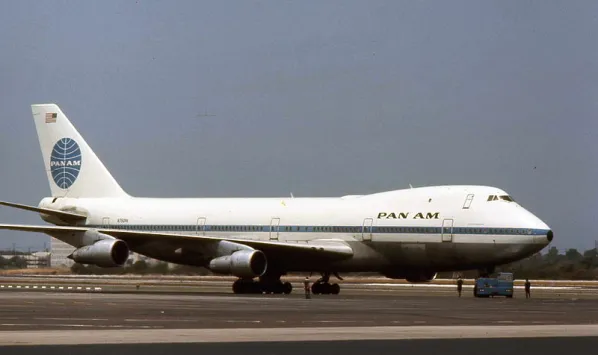
The Boeing 747 was the world's first wide-body passenger jet, first flown in 1969. This Boeing 747-100, named “Clipper Young America,” was the first of the jets to be delivered to a commercial airliner, initially christened as “Clipper Victor” by First Lady Pat Nixon on January 15th, 1970. The first 747 operated by the famous Pan American Airlines, it made the first commercial 747 flight in history on January 22nd, 1970, from New York to London. With a lot of “firsts,” the era of the “jumbo jet” had begun.
With a length of 231 feet and wingspan of 195 feet, the four-engined 747-100 was so large that Boeing had to construct a new factory to build it. Many airports could not fit them in their existing hangars for this reason. Initially designed as a military cargo aircraft, in a little over two years, it materialized as a passenger airliner of unprecedented size. It was not only the first commercial jetliner with two aisles (hence the category “wide-body”), but also the first with two decks. Indeed, the most striking feature of the 747 was its hump-like passenger lounge area, a much smaller second deck situated above the full-length first floor and right behind the cockpit.
The Boeing 747 changed air travel forever. Ten years earlier, its quadjet antecedent, the Boeing 707, kicked off the Jet Age. The 707, however, was fuel-inefficient and couldn't even carry 200 passengers. The 747, on the other hand, could carry up to 550 people with quieter and more efficient “high-bypass” engines (i.e., most air went around the engine core rather than right through it; the 747 was the first airliner to use this revolutionary design). Able to carry quadruple the passengers with decreased fuel consumption, the fare per passenger was half the fare for 707 passengers. With two aisles and separation into room-like compartments, it could accommodate these passengers in a comfortable environment.
The Boeing 747 could travel unprecedented distances at half the cost of previous airliners, making intercontinental air travel immediately accessible to millions. Tourism soared, and the affectionately-dubbed “jumbo jet” connected far-flung parts of the world like never before. Gone were the days of multi-day flight durations costing a small fortune to any flier. The 747 developed the still-extant “hub-and-spoke” system, as it necessitated the construction of large airports that served as transportation hubs in all directions. It facilitated globalization like no jetliner ever before, shuttling goods and people around the world quickly and affordably.
The Boeing 747 also indelibly embedded itself in the American public consciousness, becoming the centerpiece of many disaster movies (and some real-life disasters like the horrific Lockerbie bombing…). To this day, it ferries the president of the United States from place to place under the callsign Air Force One, and has historically transported the Space Shuttle nestled atop its roof. The Boeing 747, above all, was the ticket to the ideal vacation destination, an idea considered unfeasible only a decade prior. Its impact on American culture makes it a suitable selection for the Museum of 20th Century Technology. This era of connecting all corners of the globe began one day in January 1970, when Pan Am's Clipper Young America journeyed across the Atlantic from JFK to Heathrow.